Playing Badminton Through the Cell Phone

Well, if you are good at playing badminton with a "real" racket, what if you try to play badminton on the cellphone against your friends?

Recover Your Wet Cell Phone

Your cellphone accidentally fell to the sink? Don't worry, we have the solution for you

SIM Card Circulation Exceeds Population

The development of the mobile telecommunications industry in indonesia has been felt by 97 percent of 240 million indonesia's population.

10 Photography Application For iPhone

A Guide to your photography Zen

Headphone or Speaker? You choose!

Speaker or headphone? i'm confused!

15 Des 2011

The 10 best tablets of 2011

Tablets are the technology’s industry’s latest gold rush. With Apple selling 15 million iPads in 2010 and projected to sell as many as 45 million in 2011, everyone wants a piece of the public’s sudden infatuation with these multitouch slabs of silicon.  From the world’s biggest computer companies to obscure little parts makers, there have been an obscene number of companies releasing tablets this year and the number will only increase in 2012.

 Now that the holiday buying season has arrived, here is the latest assessment of the top tablets of 2011.


10. HTC Flyer

Over half of the tablets on this list are powered by Android and HTC is one of the powerhouses of the Android ecosystem. Unlike rivals Motorola, Samsung, and LG, who all unveiled high-end tablets at CES 2011 in January, HTC was remarkably silent on the tablet question. However, this spring, HTC announced the Flyer, a 7-incher with a 1.5 GHz CPU, 1.0 GB RAM, 32GB of Flash storage, and a special version of the HTC Sense UI designed for tablets. The Sense UI is by far the best Android skin on the market and it doesn’t disappoint on the Flyer, even though it’s running on top of Android 2.2 and not Android 3.0. Also, unlike most of the other Android tablets, the Flyer includes digital ink technology and a stylus — and it’s an excellent implementation. Unfortunately, the Flyer hardware leaves a lot to be desired. It is thick, awkward to hold, and feels like an oversized smartphone

9. HP TouchPad

For business professionals intent on productivity, there’s a lot to like about the HP TouchPad. The email and multitasking capabilities alone are enough to give it an edge over the iPad. And, we haven’t even talked about the TouchPad’s ability to print (especially to HP printers) — another important asset for some professionals. The expanded Web browsing capabilities are huge, too. It allows the TouchPad to access a lot of sites (Flash and others) that aren’t accessible from the iPad. This can open the door to Web-based business apps and other important sites.

8. BlackBerry PlayBook

 The BlackBerry PlayBook is the perfect choice for two types of tablet buyers — 1.) BlackBerry loyalists who want the perfect compliment to their smartphone and 2.) people who want a tablet primarily for mobile Web browsing from the conference room, couch, bedroom, and other places where you don’t have a full PC and don’t want to whip out a laptop.

For high security enterprises and government organizations that are already committed to the BlackBerry platform and have employees clamoring for iPads, the BlackBerry PlayBook is potentially an excellent tablet solution to run private apps and intranet services.

7. Motorola Xoom

In the technology industry, we don’t give products an “A” for effort. Things iterate too quickly. That’s why it’s tough to recommend the Motorola Xoom. There’s just too much unfinished business on this tablet, plus it’s roughly $100 more expensive than a comparable iPad 2 model.

Unless you’re an Android developer, a devout Android fan, or a bleeding edge IT professional who wants to get an early jump on Android 3.0 Honeycomb, then I’d steer clear of the Xoom — at least until everything gets cleaned up, LTE 4G is shipping as part of the standard package, and the price drops by at least $100.

Even then, Android is going to need a lot more really good tablet apps in order to compete effectively against the iPad, which has quickly become a favorite among business professionals for its approachability and plethora of software. Once it gets finished and gets more apps, the Xoom could be in the same league with the iPad. Most buyers should avoid it until then.

6. B&N Nook Color

When the Barnes & Noble Nook Color e-reader got an update to Android 2.2 and its own app store earlier this year, it turned into a viable low-cost tablet. Some will argue against it, since it has a heavy-handed UI forced on top of Android and doesn’t run the full Android Market app store. But, I couldn’t leave this little 7-inch tablet off the list. It has a great form factor — thin and easy in the hands — and you can’t beat the price at $249. Plus, if you’re highly technical, you can hack it into a full Android tablet. The Nook Color tablet will get a hardware upgrade in November.

5. Toshiba Thrive

This is the Swiss Army Knife of tablets, and I’m talking about the big Swiss Army Knife that has a zillion tools including scissors and a plastic toothpick. The Thrive is all about the specs and ports. It’s a 10-inch tablet running Android Honeycomb 3.1 and it features a removable battery, a full HDMI port, full USB port, Mini USB port, and full SD card slot. This tablet is a bit of a tank. It’s bulky and a little heavy, but also feels very sturdy, similar to the Motorola Xoom. With all of these features and a price starting at $400, the Thrive is winning over plenty of technophiles and Windows enthusiasts.

4. ASUS Eee Pad Transformer

ASUS believes that the iPad has two weaknesses — lack of choice and limited content creation ability — so that’s where the company has focused its attention in tablets. The Eee Pad Transformer is a 10-inch tablet with a dual core NVIDIA Tegra 2 CPU that runs Android 3.0. The most innovative thing about this one is that it has an optional keyboard dock that also functions as an extended battery, giving the device up to 16 hours of life. With the Transformer’s dock mode, ASUS has pulled off an Android tablet that also doubles as a laptop. Plus, the price is right. At $399, this tablet is one of the best values on the market, so it’s no surprise that it it sold out in the US on its first day of online sales.

3. Samsung Galaxy Tab 10.1

The original Samsung Galaxy Tab was a 7-inch tablet that jumped the gun on Android tablets before Google was ready, but it offered the first legitimate challenge to the original iPad. If it wasn’t so expensive ($600), it might have faired even better than the respectable sales numbers it posted. Samsung’s second try at the tablet market is a lot more potent. The Galaxy Tab 10.1 is a gorgeous piece of hardware. I usually don’t like Samsung’s plastic mobile hardware (it always feels cheap to me), but the Galaxy Tab 10.1 looks and feels great. It is razor-thin, light, and still feels sturdy. It has all the specs you’d expect for a high-end tablet — great screen, dual cameras, solid battery life, and a dual-core NVIDIA processor. The only drawback is the software. It runs Android Honeycomb with the Samsung Touchwiz UX, which adds very little, doesn’t have a very appealing UI, and doesn’t have all of the experimental features (like browser thumb controls) as stock Android. But, Samsung is making these tablets very friendly for enterprise buyers and it can run on Verizon’s 4G LTE network.

2. Amazon Kindle Fire

I’ve had the Amazon tablet on this list for most of the year, and I’ve taken a lot of heat for it since the product wasn’t officially announced until September 28. I’ve maintained throughout the year that the Amazon tablet is destined to be No. 2 in the market by the end of 2011, and I still believe that now that Amazon has unveiled the Kindle Fire. The fact is that Amazon is better positioned to compete with Apple than any of the other tablet makers because of its strengths in content and cloud computing. Amazon already had the Kindle e-book library and Web-based music and video stores, but in 2011 it has added the Amazon Appstore for Androidand Amazon Cloud Drive. The Kindle Fire has one other huge asset going for it — a $199 price tag.

1. Apple iPad 2

  The iPad 2 is a minimal refinement of the original iPad that adds a better screen, a slimmer form factor, and a dual core processor (the new cameras are barely worth mentioning). However, by retaining its great battery life, simple user experience, huge catalog of apps, and low price, the iPad 2 has enough to maintain a stronghold over the nascent multitouch tablet market. Even among business professionals — many of whom use the iPad for both work and personal use — the iPad 2 remains the tablet of choice. And, judging by the early competitors so far this year, it’s not in danger of being dethroned in 2011.

 Which tablet would you pick?

(as seen on http://www.techrepublic.com)


14 Des 2011

BMW, GM to collaborate on fuel cells

The Chevrolet Equinox Fuel Cell.
(Credit: GM)
The two automotive manufacturers will sign a cooperation agreement that gives BMW access to GM's existing fuel cell technology in exchange for research funding supplied by the German auto maker, according to reports in German weekly business magazine WirtschaftsWoche.
Both manufacturers have been developing and testing hydrogen-powered vehicles for more than two decades. After clocking more than 2 million miles during Project Driveway, GM is fleet and consumer testing its Chevrolet Equinox Fuel Cell vehicles in Hawaii. Last year BMW unveiled a 1-series hybrid fuel cell prototype that improves upon the 7-series fuel cell vehicle it tested globally.
GM has disclosed that it spent more than $1.6 billion developing its fuel cell technology so far. But rather than continue down the expensive commercialization path on its own, a partnership seems to be a good way to standardize technology while reducing costs for the entire industry. Several manufacturers, such as Hyundai, Honda, and Toyota, have pledged to bring hydrogen-fueled vehicles to the mass market by 2015, which is fast approaching. Toyota has predicted that the cost of hydrogen fuel cell technology will plunge in 2015. Perhaps these automotive collaborations are one way to ensure that happens.
BMW confirmed that it was in discussions with GM, but did not disclose details of its new technology agreement, according to Automotive News. This is the second arrangement that BMW has recently entered that pools resources to speed development of next-generation technology. Earlier this month, the luxury car builder partnered with Toyota on the development of lithium-ion batteries.

The BMW 1-Series fuel cell hybrid vehicle.
(Credit: BMW)
 (Source: Wirtschaftswoche via Automotive News)

12 Des 2011

Versatile Task Flashlight

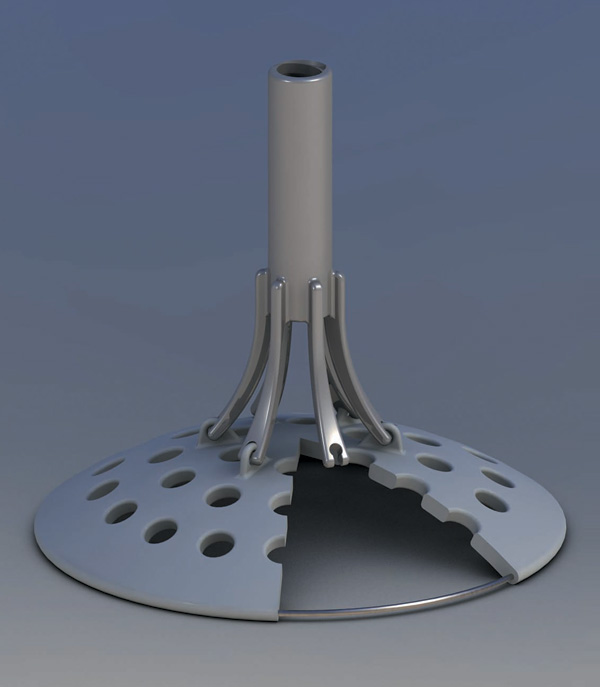
A winner of this year’s red dot: design concept award, the Adjustable Radiation Flashlight is a small, powerful, handheld task light that makes it possible to easily change the beam from concentrated spot-light to wide flood-light by use of its a flexible plastic plate which contains nearly 40 individual lights. Simply twist the tactile back cap to create whatever light is necessary.
Designer: Ezat Dayani


Future Playstation 4?

I love me some Playstation! Not only does this PS4 concept have a natural and believable aesthetic evolution from the PS3, but it is composed of 60% recyclable materials, making it a much greener choice. It also uses 0 watts in standby mode, and with its ECO Restart function games can be saved, the console turned off, and turned back on to resume exactly where the user left off without the need for a full start up, reducing energy waste and prolonging the life of the unit.Further, the unit will automatically shut off primary power after each 30 minute period of playtime and draw energy from it’s rechargeable battery for 5 minutes. The same feature also assists in preventing data loss during a power outage.
The unit connects wirelessly to any DPConnect TV, detecting the appropriate screen resolution as well as identifying the audio output, all in under 4 milliseconds so it’s ready to roll directly after being removed from the box.
Other features include: -1.5TB HDD, Full 3D 4K2K compatible, DLNA, DPhdmi (HDMI Connect), 3D Blu-ray (Blu Ray “DEUCE” Compatible, 3 times more data than the classic blu ray disc), USB 3.0, DPConnect Bravia Sync, Qriocity, Sony Ericsson sync, Cloud Saving, live TV, and even applications for weather, widgets, Gamespot, news, and more!
Designer: Joseph Dumary


11 Des 2011

QWERTY Focus

Most cellphones have joined the touchscreen bandwagon so once in a while it tickles me pink, to come across a QWERTY concept merged with the touchscreen option. The handy keyboard is placed to the right of the phone and it has a 30˚ slant to it. It’s quite a handful but in a good sense and I think we can do with a Samsung Cave!
Designer: Kim Min Seok


Voice Control, the End of the TV Remote?


Before he died on Oct. 5, Steve Jobs left clues that he was working on a new product that would revolutionize how we interact with our TVs. “It will have the simplest user interface you could imagine,” he said to biographer Walter Isaacson, and will eliminate the collections of remote controls that litter living rooms. After years of struggling with the Apple TV set-top box, which was never a huge success, “I finally cracked it,” he said.
No one knows for sure what “it” is, and Isaacson isn’t saying. But many tech executives agree that an Apple (AAPL) TV set is likely to make use of humankind’s most natural interface: the voice. Already, millions of Apple customers are talking to their new iPhone 4S, thanks to a program called Siri that tries to provide an answer to questions like, “How’s the weather today?” Whether the rumors are true that Apple is planning to release a TV set by 2013, Siri-like voice recognition is headed for the living room. Microsoft (MSFT) is already there, via its Xbox 360 game console, and Comcast (CMCSA), Samsung Electronics (SHCAY), LG, and Sharp are working on voice-enabled features for TV sets, set-top boxes, and related products. Mike Thompson, senior vice-president at Nuance Communications (NUAN), the world’s largest supplier of voice recognition technology, says “a wave” of device makers will ship products that understand voice commands next year.
It’s easy to see the appeal. Few would be upset if, instead of figuring out which one of three remotes to use, viewers could sit on the couch and say, “Record the next episode of Modern Family.” And while a growing percentage of new TVs connect to the Internet, many customers are put off by overly complex controls or on-screen keyboards that require the user to type by moving a cursor at an excruciatingly slow pace, says Jakob Nielsen, a product usability expert and co-founder of design consultancy Nielsen Norman Group. “Anything would be better than what we have now,” he says. “We can only go up from here.”
Microsoft has the early lead thanks to Kinect, an Xbox peripheral with cameras and motion sensors for hands-free gaming. Kinect also has sensitive microphones. After waking up the system by saying “Xbox,” subscribers to Microsoft’s $60-a-year Xbox LIVE service can search for shows, movies, and games by speaking to Microsoft’s Bing search engine. “You get a lot of claims saying, ‘We’re about to transform TV,’ ” says Ross Honey, general manager of Xbox LIVE entertainment and advertising for Microsoft. “We already have.”
Most consumers’ first opportunity to talk to their TVs—and have them listen—will be through voice-enabled apps for their smartphone or tablet. More than 3 million Comcast subscribers have downloaded an app that turns their smartphone into a remote control for the company’s Xfinity broadband service. Comcast is looking at adding voice-control features to the app, says spokeswoman Jennifer Khoury. Samsung and Sharp are developing similar apps of their own, according to people familiar with their plans. This may well have been the approach Jobs had in mind. According to one former Apple manager who asked to remain anonymous because he was not authorized to speak publicly, Jobs saw little reason for a stand-alone remote when iPhones and iPads can do the job better.
Others are looking to fix rather than eliminate the remote. Nuance’s Thompson says TV, DVD, and set-top box makers are all working on models that look more like iPhones, some with touchscreens rather than that gaggle of unused buttons. Some of the prototypes are designed around a single prominent button that activates a microphone, he says. Cost will be a challenge, since such a device would need a microphone and Wi-Fi antenna instead of the infrared sensors now commonly used. Industry politics will also be an issue. Since having every electronic box within earshot respond at once would be a nightmare, equipment makers need to agree on which device runs the show.

The best approach of all, says design expert Nielsen, is to have no remote at all. Nuance is researching ways to embed microphones around the living room, like so many home-theater speakers—the better to discern words, says Thompson. And TV makers are looking into building mics right into TVs. Piper Jaffray (PJC) analyst Gene Munster expects such devices from Apple in 2013, but others may be on the market by then. Nuance’s Thompson estimates that 5 percent of TVs could have built-in voice control by Christmas 2012.
Dave Grannan, chief executive officer of voice software maker Vlingo, expects many technologies to be integrated eventually. In his dream scenario, he’ll be able to tell his TV to pull up his Netflix (NFLX) queue. Using Kinect-style motion control, he could then air-swipe through his library. Thanks to eye-tracking software in the TV or set-top box, he would simply look at the movie he wants to watch and say, “Play that.” “The combination of voice, gesture, and eye tracking is the future,” says Grannan. He says Vlingo will announce its first voice recognition product for TV at the International Consumer Electronics Show that begins on Jan. 10.
Major hurdles remain. “The living room is tough,” says Dag Kittlaus, who co-founded Siri, the voice control technology startup bought by Apple in 2010. Kittlaus left Apple in October and is now writing a sci-fi novel (which, yes, involves computers that listen). Voice recognition products in the living room need to be able to distinguish voice commands from casual chitchat, screaming kids, and the sounds coming from the TV itself. Also, most TVs don’t share a common operating system such as Windows for which developers can create new applications. “The minute someone comes along with an ‘app store’ for TV, it will break wide open and transform the experience,” says Kittlaus. “As it stands, the only people who have access to what you see on the TV are the TV makers and cable guys.” A startup called Zypr, founded by consumer electronics maker Pioneer, has developed standards for speech-enabled devices but has yet to announce partners.
The biggest challenge, however, is simply making the software smarter. Kinect users are limited to a handful of commands, and plenty of iPhone 4S owners have already tired of hearing Siri tell them, “I don’t understand.” That means the heaviest lifting still needs to be done by the technology companies that have worked for decades on artificial intelligence. SRI International, the Silicon Valley research lab that created the Siri technology before spinning it off as a separate company, is working on software to allow for far more advanced computer-human dialogue. There’s even a project to enable technology to discern a person’s mood by picking up on verbal cues. “Siri is the beginning of the story, or near the beginning of the story,” says SRI Vice-President Norman Winarsky, an early champion of Siri. “There’s much more to come.”

ZTE to Launch High-End Smartphone in U.S.

ZTE Corp. plans to launch a high-end smartphone in the U.S. in the middle of next year, an executive said, marking a change from its low-cost emphasis and putting it in head-to-head competition with the likes of Apple Inc., HTC Corp., Samsung Electronics Co. and Nokia Corp. in a high-end market that's growing ever more crowded.
"By 2015, we expect the U.S. to be the largest market for handsets for ZTE," Lixin Cheng, president of the Chinese company's North American region, said in an interview Wednesday in Hong Kong.
Long known for making phones on a contract basis—in addition to telecom equipment—ZTE is shifting its focus to building its own brand of mobile devices, and is building market share: In the third quarter, it had 5% of the global handset market, pushing it past Apple to No. 4 by shipments, according to research firm Strategy Analytics.
In the U.S. smartphone market, where the company's share is so small it's lumped in the "other" category—trailing, among others, Apple and Taiwan-based HTC—ZTE offers a model that retails for as little as $89 in the U.S. with a carrier's subsidy.
"Next year, we're going to launch LTE and high-tier phones in the U.S.," Mr. Cheng said. LTE, for long-term evolution, is a fourth-generation wireless technology that allows faster download speeds than current 3G technology.
The company, which is listed in Shenzhen and Hong Kong, is in talks with the top four U.S. carriers about the phone, likely to be based on Google Inc.'s Android software or Microsoft Corp.'s Windows 7 platform, said the executive.
"With a similar feature set [as the iPhone], ZTE can offer an alternative," said Mr. Cheng, adding that the phones would still be "more affordable" than the iPhone, though he declined to specify price points.
The ZTE strategy contrasts with that of the top handset vendors, Nokia and Samsung, which are looking to tap into strong demand in emerging markets like Brazil and India by beefing up low-end offerings—despite razor-thin profit margins. Samsung has launched feature phones that cost as little as €25 ($33.50) in Europeand smartphones in India in the $100-to-$150 range. The Nokia 600 phone, unveiled in August, retails for $260, about half the cost of an iPhone 4.
Typically, a high-end smartphone costs more than $400. Samsung has forecast that by 2015, smartphones selling for less than $200 will represent about 50% of the market by volume.
Though the U.S. economic slowdown and the crisis in Europe are weighing on consumer demand for gadgets, the executive said ZTE is upbeat about its growth prospects in North America. Its U.S. shipments of mobile devices in the third quarter were up 157% from a year earlier, he said.
The company, is also considering building a manufacturing facility to make mobile devices in the U.S., he said, where it now has 10 offices and three research and development facilities. ZTE has 400 employees across North America.
"We have increased substantially our employees and we're constantly adding staff" in areas such as local R&D, he said. ZTE's staff levels in the U.S. increased about 30% between 2010 and 2011.
Mr. Cheng said the company sees bigger U.S. opportunities in mobile devices than telecom equipment, where security issues may make it difficult for Chinese vendors to get contracts. Sprint Nextel Corp. excluded ZTE and rival Huawei Technologies Ltd. from a contract worth billions of dollars largely because of national-security concerns in Washington, people familiar with the situation told The Wall Street Journal last year.
"We don't see near-term big opportunities in the infrastructure business," said the executive.

Twitter Delicious Facebook Digg Stumbleupon Favorites More